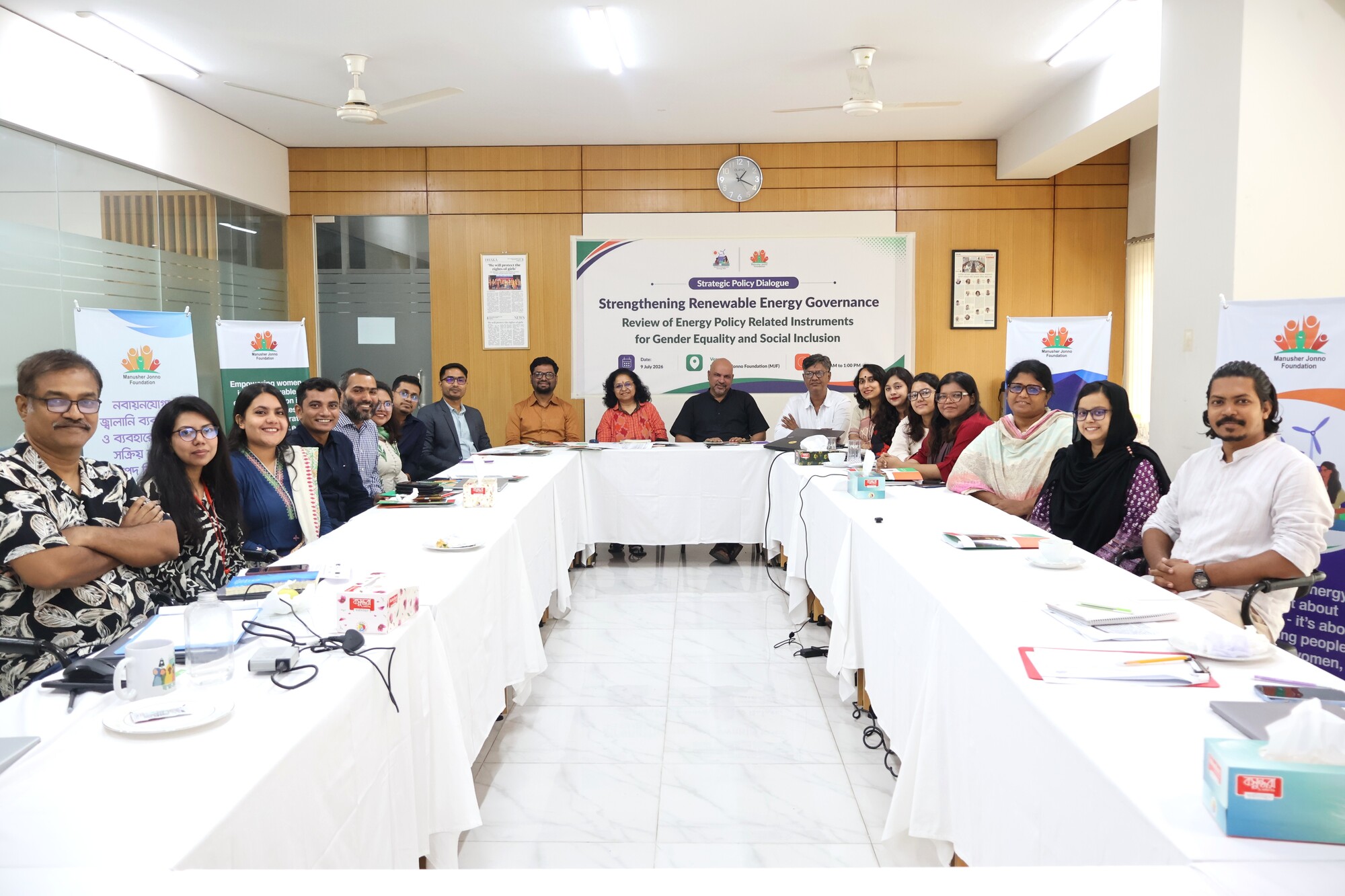
Discussants and participants at a strategic policy dialogue held on Thursday, July 9, 2026, at Manusher Jonno Foundation’s office in Mirpur, Dhaka.
Press Release
09/07/2026
Policy Dialogue: Renewable energy policy related instruments must include women, marginalised groups
Dhaka, July 9, 2026: Renewable energy is not merely about power generation. It is directly linked to people’s lives, work, income, safety and rights, speakers said at a policy dialogue on Thursday (July 9). They called for the needs of women and marginalised communities to be clearly reflected in the Draft National Renewable Energy Development Strategy (2026-2030) and the Rooftop Solar Operation and Maintenance Guidelines.
The strategic policy dialogue, titled “Strengthening Renewable Energy Governance: Review of Energy Policy Related Instruments for Gender Equality and Social Inclusion”, was organised by Manusher Jonno Foundation (MJF) under its Women’s Empowerment and Energy (WEE) project.
The discussion focused on two draft documents reviewed by MJF from the perspective of gender equality and social inclusion: the Draft National Renewable Energy Development Strategy (2026-2030) and the Rooftop Solar Operation and Maintenance Guidelines. Participants also discussed where and how gender concerns could be addressed in the two documents.
Banasree Mitra Neogi, Director – Rights and Governance Programmes at MJF, said the draft strategy and guidelines on renewable energy still do not adequately reflect the participation of women entrepreneurs and marginalised communities.
“These documents have been reviewed from the lens of gender equality and social inclusion. Civil society must play the role of a pressure group,” she said.
She added that while policies provide direction, a legal basis is needed to make compliance mandatory. The draft documents should also be made public so that people from different levels can provide their opinions, she said.
Presenting the keynote paper, Wasiur Rahman Tonmoy, Lead – Youth and Social Cohesion at MJF, said an analysis of the two recent draft policy instruments shows that relevant stakeholders were not adequately consulted during their preparation.
He said women and marginalised communities have not been sufficiently mentioned in the documents. Calling for special incentives and easier access to loans for them, he said the strategy, guidelines and related policies for the renewable energy sector must be made more realistic and inclusive through consultations with the government, civil society, private sector, development partners and experts.
Shahnaj Siddiqui, General Secretary of Bangladesh Nari Sangbadik Kendra (BNSK), said policies and projects should include a comparative analysis of the benefits of including marginalised communities and the losses caused by excluding them. She also suggested incorporating renewable energy into the education curriculum.
ASM Munir, Company Secretary of the Bangladesh Sustainable and Renewable Energy Association (BSREA), said renewable energy should not remain confined to solar home systems. Policies should be formulated by considering the entire ecosystem, including distribution systems, importers, users and social impact, he said.
Jannatul Ferdaus, Research Officer at Ethical Trading Initiative Bangladesh, said the draft documents should clearly outline the involvement of the Ministry of Women and Children Affairs. Otherwise, it will remain unclear how women’s issues will be incorporated during implementation, she said.
Sazzad Hossain, Assistant Vice-President of Infrastructure Development Company Limited (IDCOL), said the strategy and guidelines were prepared largely from a technical perspective.
He said the documents should not only set megawatt-based targets, but also include targets on how many people would benefit. He also called for easier access to finance for women and marginalised communities.
Sadia Jahan Rothi, Environmental Management and Youth Engagement Specialist at the Centre for Climate Change and Environmental Research (C3ER), Brac University, said practical labs on renewable energy should be introduced in the education system so that girls can gain hands-on experience and develop interest in the sector.
Md. Newazul Moula, Coordinator (energy governance) at Transparency International Bangladesh, said a strategy should include background, strategic direction and a time-bound implementation roadmap. He stressed the need to include social audits, local people’s opinions, good governance and accountability in the documents.
Marzia Islam of ActionAid Bangladesh said public services should be made more accessible and a helpline should be introduced if necessary. She also called for a roadmap on battery management to prevent environmental damage caused by unsafe disposal or handling.
Hasan Mehedi, Chief Executive of Coastal Livelihood and Environmental Action Network (CLEAN), said agriculture is one of the most promising areas for renewable energy, but women and marginalised communities are being left out of target-setting.
He stressed the need to address land leasing, power sector efficiency, women’s training, incentives for women contractors and labour-based maintenance systems.
Participants said policy formulation should not be limited to experts or government officials. Local communities, women’s organisations, farmers, entrepreneurs, civil society and the private sector should also be consulted. They said policies would not be effective at the field level without the experiences of those who use electricity, install solar panels, repair systems or remain excluded from services.
The dialogue also highlighted the need to ensure accountability, social audits, safe working conditions, local employment, women’s entrepreneurship, easy loans, repair services, battery management and the participation of marginalised communities in renewable energy policies. MJF said recommendations from the dialogue would be compiled into policy recommendations and a policy brief and shared with the relevant authorities.
প্রেস বিজ্ঞপ্তি
০৯/০৭/২০২৬
নবায়নযোগ্য জ্বালানি-খাতের নীতিসমূহে জেন্ডার সমতা ও সামাজিক অন্তর্ভুক্তি নিয়ে সংলাপ: নারী, প্রান্তিক জনগোষ্ঠীকে অন্তর্ভূক্তির দাবি
ঢাকা, ০৯ জুলাই ২০২৬: নবায়নযোগ্য জ্বালানি শুধু বিদ্যুৎ উৎপাদনের বিষয় নয়, এটি মানুষের জীবন, কাজ, আয়, নিরাপত্তা ও অধিকার-এর সঙ্গে সরাসরি যুক্ত। তাই খসড়া জাতীয় নবায়নযোগ্য জ্বালানি উন্নয়ন কৌশলপত্র (২০২৬–২০৩০) এবং রুফটপ সোলার পরিচালনা ও রক্ষণাবেক্ষণ নির্দেশিকায় নারী ও প্রান্তিক জনগোষ্ঠীর প্রয়োজন স্পষ্টভাবে অন্তর্ভুক্ত করার দাবি জানিয়েছেন বক্তারা।
আজ বৃহস্পতিবার (৯ জুলাই) মানুষের জন্য ফাউন্ডেশন (এমজেএফ)-এর উইমেনস এমপাওয়ারমেন্ট অ্যান্ড এনার্জি (উই) প্রকল্পের উদ্যোগে “জেন্ডার সমতা ও সামাজিক অন্তর্ভুক্তি নিশ্চিতকরণে জ্বালানি-খাতের নীতি ও নীতিগত উপকরণসমূহের পর্যালোচনা”শীর্ষক নীতি সংলাপ (পলিসি ডায়লগ) অনুষ্ঠিত হয়। সংলাপে এমজেএফের পক্ষ থেকে জেন্ডার সমতা ও সামাজিক অন্তর্ভুক্তির দৃষ্টিকোণ থেকে পর্যালোচিত দুটি খসড়া দলিল, খসড়া জাতীয় নবায়নযোগ্য জ্বালানি উন্নয়ন কৌশলপত্র (২০২৬–২০৩০) এবং রুফটপ সোলার পরিচালনা ও রক্ষণাবেক্ষণ নির্দেশিকা, পর্যালোচনাপূর্বক আলোচনা হয়। এছাড়াও কোন কোন অংশে জেন্ডার বিষয়টি সম্বোধন করা যায় যে বিষয়ে বিস্তর আলাপ হয়।
মানুষের জন্য ফাউন্ডেশনের রাইটস অ্যান্ড গভর্ন্যান্স প্রোগ্রামসের পরিচালক বনশ্রী মিত্র নিয়োগী বলেন, নবায়নযোগ্য জ্বালানি খাত সম্পর্কিত খসড়া কৌশলপত্র ও নির্দেশিকায় নারী উদ্যোক্তা ও প্রান্তিক জনগোষ্ঠীর অংশগ্রহণ এখনো যথেষ্টভাবে আসেনি। এগুলোকে জেন্ডার সমতা ও সামাজিক অন্তর্ভুক্তির দৃষ্টিভঙ্গি থেকে দেখা হয়েছে। নাগরিক সমাজকে চাপ সৃষ্টিকারী শক্তি হিসেবে কাজ করতে হবে। তিনি আরও বলেন, নীতি পথ দেখায়, কিন্তু তা মানা বাধ্যতামূলক করতে হলে আইনগত ভিত্তি দরকার। এছাড়াও খসড়া দলিলগুলো সবার জন্য উন্মুক্ত রাখা দরকার, যাতে বিভিন্ন পর্যায়ের মানুষ মতামত দিতে পারে।
সংলাপে মূল প্রবন্ধ উপস্থাপনকালে এমজেএফের লিড – ইয়ুথ অ্যান্ড সোশ্যাল কোহিশন ওয়াসিউর রহমান তন্ময় বলেন, সাম্প্রতিক দুইটি খসড়া নীতিগত উপকরণ বিশ্লেষণ করে দেখা গেছে, এগুলো তৈরির সময় সংশ্লিষ্ট অংশীজনদের সঙ্গে যথেষ্ট পরামর্শ করা হয়নি। নারী ও প্রান্তিক জনগোষ্ঠীর বিষয়ে যথেষ্টভাবে উল্লেখ নেই। তাদের জন্য বিশেষ প্রণোদনা এবং সহজ ঋণ ব্যবস্থার প্রয়োজনীয়তার কথা উল্লেখ করে তন্ময় জোর দাবি জানান – সরকার, নাগরিক সমাজ, বেসরকারি খাত, উন্নয়ন সহযোগী ও বিশেষজ্ঞদের মতামতের ভিত্তিতে নবায়নযোগ্য জ্বালানি খাতের কৌশলপত্র, নির্দেশিকা ও সংশ্লিষ্ট নীতিমালা আরও বাস্তবসম্মত ও অন্তর্ভুক্তিমূলক করতে হবে।
বাংলাদেশ নারী সাংবাদিক কেন্দ্রের সাধারণ সম্পাদক শাহনাজ সিদ্দীকি বলেন, নীতি ও প্রকল্পে প্রান্তিক জনগোষ্ঠীকে যুক্ত করলে কী লাভ এবং বাদ দিলে কী ক্ষতি হয়, তার তুলনামূলক বিশ্লেষণ থাকা দরকার। তিনি নবায়নযোগ্য জ্বালানি বিষয়টি শিক্ষাক্রমে যুক্ত করার পরামর্শ দেন।
এদিকে বাংলাদেশ টেকসই ও নবায়নযোগ্য জ্বালানি অ্যাসোসিয়েশন (BSREA)-এর কোম্পানি সচিব এ এস এম মুনির বলেন, নবায়নযোগ্য জ্বালানিকে শুধু সোলার হোম সিস্টেমে সীমাবদ্ধ রাখলে হবে না। পুরো ইকোসিস্টেম, বিতরণ ব্যবস্থা, আমদানিকারক, ব্যবহারকারী এবং সামাজিক প্রভাব বিবেচনায় নিয়ে নীতি প্রণয়ন করতে হবে।
ইথিক্যাল ট্রেডিং ইনিশিয়েটিভ বাংলাদেশের রিসার্চ অফিসার জান্নাতুল ফেরদৌস বলেন, খসড়া দলিলগুলোতে মহিলা ও শিশু বিষয়ক মন্ত্রণালয়ের সম্পৃক্ততা নিয়ে স্পষ্ট নির্দেশনা থাকা জরুরি, নইলে নারীর বিষয়গুলো কীভাবে বাস্তবায়নে যুক্ত হবে তা অস্পষ্ট থেকে যাবে।
ইনফ্রাস্ট্রাকচার ডেভেলপমেন্ট কোম্পানি লিমিটেড (ইডকল)-এর অ্যাসিস্ট্যান্ট ভাইস প্রেসিডেন্ট সাজ্জাদ হোসেন বলেন, কৌশলপত্র ও নীতিমালা মূলত প্রযুক্তিগত দৃষ্টিভঙ্গি থেকে তৈরি হয়েছে। শুধু মেগাওয়াট লক্ষ্য নয়, কত মানুষ উপকৃত হবে সেটিও লক্ষ্য হিসেবে যুক্ত করতে হবে। নারী ও প্রান্তিক জনগোষ্ঠীর জন্য অর্থায়ন আরও সহজলভ্য করার আহ্বান জানান তিনি।
ব্র্যাক বিশ্ববিদ্যালয়ের সেন্টার ফর ক্লাইমেট চেঞ্জ অ্যান্ড এনভায়রনমেন্টাল রিসার্চ (C3ER)-এর এনভায়রনমেন্টাল ম্যানেজমেন্ট অ্যান্ড ইয়ুথ এনগেজমেন্ট স্পেশালিস্ট সাদিয়া জাহান রথী বলেন, শিক্ষা ব্যবস্থায় নবায়নযোগ্য জ্বালানি বিষয়ক ব্যবহারিক ল্যাব যুক্ত করা দরকার, যাতে মেয়েরা হাতে-কলমে শিখতে পারে এবং এ খাতে আগ্রহী হয়।
ট্রান্সপারেন্সি ইন্টারন্যাশনাল বাংলাদেশের কোঅর্ডিনেটর, এনার্জি গভর্ন্যান্স, মো. নেওয়াজুল মাওলা বলেন, কৌশলপত্রে ভূমিকা, কৌশল ও সময়ভিত্তিক বাস্তবায়ন রোডম্যাপ থাকা উচিত। তিনি সামাজিক নিরীক্ষা, স্থানীয় মানুষের মতামত, সুশাসন ও জবাবদিহি যুক্ত করার ওপর গুরুত্ব দেন।
অ্যাকশনএইড বাংলাদেশের মার্জিয়া ইসলাম বলেন, সরকারি সেবা সহজলভ্য করতে হেল্পলাইন থাকা দরকার। তিনি ব্যাটারি ব্যবস্থাপনার জন্য রোডম্যাপ প্রণয়নের আহ্বান জানান, যাতে অনিরাপদ ব্যবস্থাপনার কারণে পরিবেশের ক্ষতি না হয়।
কোস্টাল লাইভলিহুড অ্যান্ড এনভায়রনমেন্টাল অ্যাকশন নেটওয়ার্ক (CLEAN)-এর প্রধান নির্বাহী হাসান মেহেদী বলেন, কৃষি, নবায়নযোগ্য জ্বালানির অন্যতম সম্ভাবনাময় খাত হলেও লক্ষ্য নির্ধারণে নারী ও প্রান্তিক জনগোষ্ঠী বাদ পড়ে যাচ্ছে। তিনি ভূমি লিজ, বিদ্যুৎ খাতের দক্ষতা, নারীদের প্রশিক্ষণ, নারী ঠিকাদারদের প্রণোদনা এবং মানবশ্রমভিত্তিক রক্ষণাবেক্ষণ ব্যবস্থার ওপর গুরুত্ব দেন।
অংশগ্রহণকারীরা বলেন, নীতি তৈরির আগে শুধু বিশেষজ্ঞ বা সরকারি মহলের সঙ্গে নয়, স্থানীয় মানুষ, নারী সংগঠন, কৃষক, উদ্যোক্তা, নাগরিক সমাজ ও বেসরকারি খাতের সঙ্গেও আলোচনা করা দরকার। বাস্তবে যারা বিদ্যুৎ ব্যবহার করেন, সৌর প্যানেল বসান, মেরামত করেন বা সেবা থেকে বঞ্চিত থাকেন, তাদের অভিজ্ঞতা ছাড়া নীতি মাঠপর্যায়ে কার্যকর হবে না। সংলাপে নবায়নযোগ্য জ্বালানি নীতিতে জবাবদিহি, সামাজিক নিরীক্ষা, নিরাপদ কাজের পরিবেশ, স্থানীয় কর্মসংস্থান, নারী উদ্যোক্তা তৈরি, সহজ ঋণ, মেরামত সেবা, ব্যাটারি ব্যবস্থাপনা এবং প্রান্তিক জনগোষ্ঠীর অংশগ্রহণ নিশ্চিত করার ওপর গুরুত্ব দেওয়া হয়। এমজেএফ জানায়, সংলাপ থেকে পাওয়া মতামতগুলো একত্র করে নীতি সুপারিশ ও পলিসি ব্রিফ আকারে সংশ্লিষ্ট কর্তৃপক্ষের কাছে তুলে ধরা হবে।
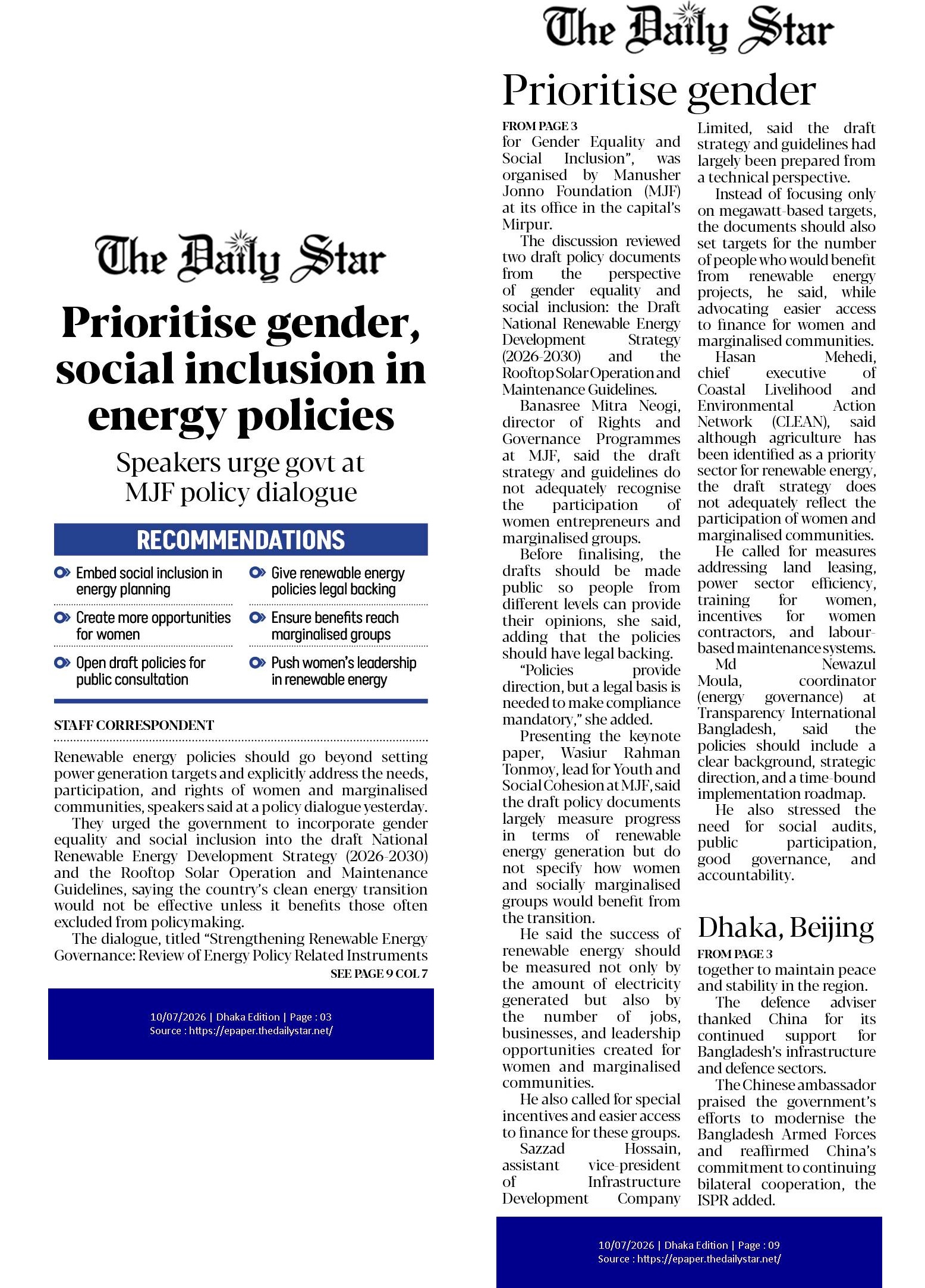
Media Coverage:


Leave a Reply